Summary
✨ AI‑Generated
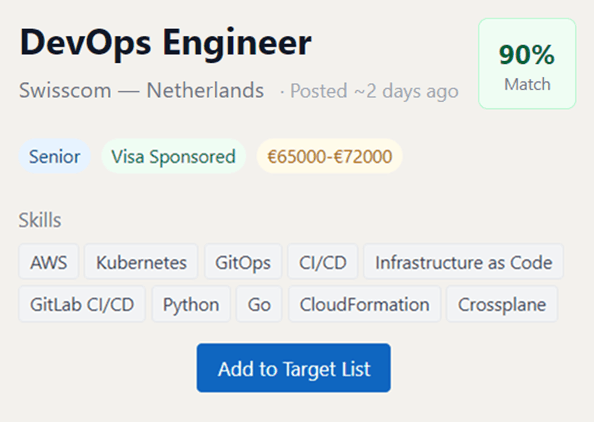
Own the path from code to production as a DevOps Engineer. You will build and maintain CI/CD pipelines for web, mobile, and backend engineering teams, automate environment provisioning in a cloud environment, and make releases frequent, repeatable, and reliable. The role is ideal for an engineer who enjoys release engineering, infrastructure automation, and improving developer delivery workflows.
Highlights
Own the delivery path from code to production, automate infrastructure provisioning, improve release reliability, and work closely with web, mobile, and backend engineering teams in a fast-moving technology environment.
Description
DevOps Engineer
About the Company
Sportech is building the digital infrastructure layer for sports clubs, leagues, academies, and federations globally.
The platform enables organizations to launch their own branded fan engagement ecosystem including memberships, livestream monetization, digital gifting, ticketing, prediction features, merchandise, and interactive experiences — all under a revenue-sharing model with zero upfront cost for partners.
Role
Own the path from code to production for the Sportech platform.
The DevOps Engineer builds and maintains the build, test and deployment pipelines used by the web, mobile and backend teams, automates environment provisioning on OCI, and works to make releases frequent, repeatable and low-drama — including around a fixture calendar that leaves little room for a bad deployment.
Where the Infrastructure Engineer owns the platform, this role owns the delivery process that runs on it.
Key Responsibilities
CI/CD and release engineering
Build and maintain CI/CD pipelines using OCI DevOps Service, GitLab CI, GitHub Actions, Jenkins or Azure DevOps.Automate build, unit and integration test execution, artefact publishing and deployment to development, staging and production environments.Maintain mobile build and release pipelines for iOS and Android, including code signing, beta distribution and store submission.Manage artefact and container registries, including OCI Container Registry and OCI Artifact Registry.Implement deployment strategies such as blue-green and rolling releases, and maintain reliable rollback paths that can be executed under pressure.Operate release controls around the fixture calendar — deployment freezes before major matches, and a defined path for urgent fixes during them.Maintain branching, versioning and release conventions in Git, and support developers who run into trouble with them.Infrastructure as code and environment management
Write and maintain Terraform, or OCI Resource Manager stacks, so environments can be rebuilt from source rather than by hand.Use Ansible or equivalent configuration management to keep server and application configuration consistent.Provision and manage ephemeral environments for feature branches, testing and demonstrations.Manage application configuration and secrets through OCI Vault, and keep credentials, stream keys and DRM material out of source control.Support feature flag and configuration tooling so that features can be enabled or disabled without a redeploy.Containers and orchestration
Write and optimise Dockerfiles, and manage container image lifecycle and tagging.Deploy and operate workloads on OKE (Oracle Kubernetes Engine), including Helm charts, ingress, autoscaling and resource limits.Tune deployments for stateful and long-lived connections, such as chat gateways, where a rolling restart is not free.Troubleshoot container and cluster issues alongside development teams.Observability and reliability
Instrument applications and pipelines with OCI Monitoring, Logging, and tooling such as Prometheus and Grafana.Build dashboards and alerts that reflect service health and viewer experience — playback failures, chat delivery latency, API error rates — rather than raw resource metrics.Prepare and run match-day readiness checks, and stand by for high-profile fixtures as part of a rotation.Take part in incident response for production services, and contribute to post-incident reviews.Track and help improve delivery metrics — deployment frequency, lead time, change failure rate and time to restore.Collaboration and security in the pipeline
Work directly with backend, web and mobile developers to remove friction in the build, test and deploy cycle.Integrate automated security checks into pipelines — dependency scanning, container image scanning and static analysis — in coordination with the security team.Document pipelines, environments and standard operating procedures.
Qualifications & Experience
Bachelor’s degree in Computer Science, Software Engineering, Information Technology, or equivalent practical experience.Two to five years in DevOps, platform engineering, software engineering or cloud operations.Hands-on experience with Terraform.Hands-on experience building and maintaining CI/CD pipelines on at least one platform.Working knowledge of at least one major cloud platform.
OCI experience is strongly preferred; AWS, Azure or GCP experience will be considered where the candidate can demonstrate transferable depth.Solid Git skills, including branching strategies and merge conflict resolution.Docker experience, and a working understanding of Kubernetes concepts.Scripting ability in Python, Bash or Go.Comfortable on Linux, particularly RHEL or Oracle Linux.Willingness to support releases and incidents around live fixtures, including evenings and weekends.
Benefits
Remote work flexibility.Competitive compensation.Professional growth opportunity.