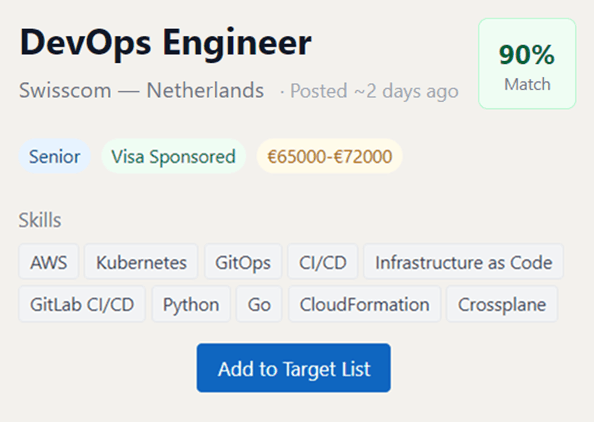
DevOps Engineer

Cubestech Ltd — United Kingdom · Posted ~22 hours ago

Skills

Platform Engineering System Design Application Development Testing Operational Stability CI/CD Cloud-Native Architecture Kubernetes Private Cloud VSI Network Segmentation Ingress/Egress Controls Service-to-Service Connectivity Terraform Python Bash Automation AWS

🔓 Log in to save this job, tailor your resume & track your apply process — 7 days free, no card needed.

Log in to add to target list

Summary ✨ AI‑Generated

A DevOps engineering position centered on cloud-native infrastructure, continuous delivery, automation, and operational reliability. The role involves Kubernetes and private cloud environments, secure network connectivity, Terraform, and Python/Bash scripting.

Highlights

Work with modern cloud-native infrastructure, CI/CD automation, Kubernetes, Terraform, and scripting while contributing to reliable and secure production platforms.

Description

Required qualifications, capabilities, and skills · Formal training or certification on Platform Engineering concepts · Hands-on practical experience delivering system design, application development, testing, and operational stability · Proficiency in automation and continuous delivery methods (CI/CD) · Practical cloud-native experience across private cloud VSI and Kubernetes, including a clear understanding of the trade-offs between the two · Strong understanding of network boundaries - segmentation, ingress/egress controls, service-to-service connectivity, and secure zone-to-zone traffic flow · DevOps toolchain expertise - CI/CD, Kubernetes, Terraform · Strong scripting and automation skills using Python and Bash for tooling, orchestration, and operational tasks Preferred qualifications, capabilities, and skills · Certifications a plus - CKA, CKAD, AWS (e.g., Solutions Architect, DevOps Engineer) · Private cloud VSI vs. Kubernetes platform experience - provisioning, deploying, and operating workloads on Virtual Server Instances alongside container orchestration platforms · Load balancing - L4/L7 load balancers, traffic distribution, and high-availability patterns · Serverless technologies (e.g., AWS Lambda) and event-driven architectures · Networking and scaling - DNS, routing, auto-scaling, horizontal/vertical scaling, and performance tuning under load · AWS (ECS, EKS, MSK) · CDN, WAF, and network boundary / perimeter design