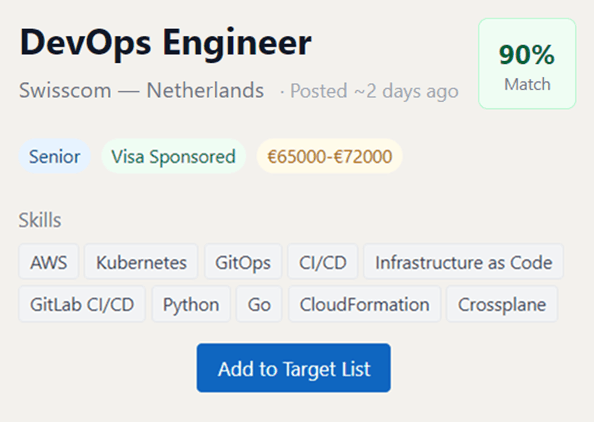
Principal Software Engineer – Microscopy Data Management & Cloud Platform
Revvity — Estonia · Posted ~4 days ago
🔓 Log in to save this job, tailor your resume & track your apply process — 7 days free, no card needed.
Log in to add to target listDescription
Role Summary
We are looking for a hands-on Principal Software Engineer to design and implement a distributed scientific data platform for microscopy and life-science applications.
The platform must support microscopy image data, metadata, search, transformation, storage, transfer and analysis workflows across instruments, user PCs, on-premise deployments and AWS cloud environments.
This role requires deep expertise in database-centric system design, high-throughput data pipelines, reliable data transfer protocols, backend interface design and scalable multi-user distributed systems.
You will
Contribute to the design and development of a distributed data management platform for microscopy and scientific imaging workflows.Design scalable storage, indexing, search, caching and high-throughput data-transfer mechanisms for large scientific datasets in hybrid edge/on-prem/cloud environments.Design and implement robust backend interfaces (APIs, contracts, schemas) enabling interoperability across platforms (instrument control, image analysis, UI, cloud services).Design and implement reliable and resumable data transfer pipelines between instruments, local systems and cloud (including offline-first and intermittent connectivity scenarios).Develop high-performance data ingestion, streaming and transformation pipelines for large image datasets and metadata.Define and implement data consistency, integrity and traceability mechanisms (checksums, versioning, audit trails, reproducibility).Collaborate with image analysis, web UI, instrument software and domain experts to define robust interfaces and end-to-end workflows.Contribute to engineering standards, CI/CD, observability, reliability and secure software delivery for cloud-based and instrument-hosted systems.Provide technical leadership through architecture decisions, hands-on implementation, design reviews, mentoring and cross-team alignment.
Must have
MS in STEM or equivalent practical experience10+ years in software engineering, including design of complex distributed backend or data platforms.Strong programming skills in Python and C#.Deep expertise in database design, schema evolution, query optimization, transactions, indexing, data security and data lifecycle management.Strong experience in backend API design (REST/gRPC), contract versioning, backward compatibility and interface governance.Understanding of network protocols and performance tuning (HTTP/2, gRPC, TCP/IP behavior, latency vs throughput trade-offs).Experience with asynchronous and event-driven architectures (message queues, streaming systems).Experience with data integrity mechanisms (checksums, hashing, validation, consistency models).Proven experience with AWS-based backend systems, storage, compute and scalable service design.Strong architectural thinking, system decomposition and performance optimization skills.
Nice to have
Experience with scientific or imaging data systems, ideally microscopy, digital imaging or laboratory software.Experience with microscopy image metadata, OME concepts, image file formats, tiled or multiresolution image handling or scientific imaging pipelines.Experience designing search solutions for complex metadata and dataset discovery.Experience building secure multi-user systems with authentication, authorization and auditability.Experience with S3-compatible object storage, hybrid deployments and on-prem/cloud synchronization.Experience with caching, asynchronous workflows, data pipelines and event-driven architectures.Experience with regulated or quality-driven environments.Experience with access control integration, Keycloak, LDAP/AD or customer-specific identity systems.C++/Bash/PowerShellDocker/Kubernetes/TerraformVector search or AI/ML data retrieval patternsExperience with life-science ontologies and scientific data standards
We have 79,401 jobs that might be an even better fit for you
DontApply's real value goes far beyond a single job link or company name. Just upload your resume — in under a minute we'll analyze all 79,401 jobs and tell you exactly which ones you should apply to right now.
Upload My Resume